


finspectcheck.live: the landing page and guide.
Three engineers gave me three answers about one foundation. So I read the rules myself and built the guide owners need: six steps, a flood zone lookup, and a report check that turns an engineer’s report into questions. Designed by me, built in about a week with Claude Code.
finspectcheck.live: the landing page and guide.
I wanted proof I could prototype in code and design AI agents, on something real. finspectcheck.live is that proof, and it helps people avoid a headache we hit buying our house.
No foundation certification, no mortgage. Before a lender will finance a manufactured home, an engineer has to certify the foundation, and the fix list can mean expensive construction first.
The catch: engineers don't agree on which rules apply. I hired three and got three different answers.
Product designer and design engineer: research, content design, Figma mockups and logo, and direction of an AI-built codebase. I reviewed every change before it went in.
About a week, October 2026
One designer, two AIs. Claude Code did most of the typing; Claude desktop dug through sources and sharpened copy. Specs and every word of copy live in plain Markdown files so I could keep the copy clear of AI's inevitable drift into abstractions.
Work a designer and developers once split, I directed through AI. Left alone, Claude Code drifts: it builds a custom version of a component for each page instead of reusing one, and it reaches for phone layouts before the content has settled.
It's also confident when it's wrong, and its reports bury the one thing that needs me under pages of detail. And long, research-heavy work outgrows a chat's memory.
One wanted the space under the house closed in, plus 28 tie-downs. Another wanted a brick, block or wood wall on a new concrete footing, and quoted $1,295 for plans showing how. The third certified it after we added tie-down straps. None of them looked up our flood zone, which changes the rules. (The full story.)
A foundation can be judged against up to four sets of rules. Your loan picks one of two: HUD's 1996 foundation guide, or the home maker's installation instructions. Where you live can add two more: local codes, and FEMA's flood rules if you're in a flood zone. Few buyers have heard of any of them, and even professionals can blur them.
Only a licensed engineer can certify a foundation. So the site never says a foundation passes, or that a report is wrong. It gives buyers the rules, and the questions to ask. That one constraint shaped every screen.
This time I had better tools. Claude searched federal code, HUD's handbook and FEMA's rules in minutes. It still took a lot of questions. Early on, the AI assumed the lender sets the foundation rules. It doesn't: the loan only picks which rulebook applies.
So every rule on the site carried a "Needs verification" badge until I'd read it in the source. AI sounds just as sure when it's wrong. Checking changed the copy more than once: FHA accepts an engineer or architect licensed in the home's state, and USDA asks for "HUD standards" without naming the 1996 guide.
The biggest finding: extras slip in because so few people know the actual rules. Not most buyers, and not many of the agents who guide them.
When we bought our home, ChatGPT didn't exist yet. Two of the three engineers wanted it enclosed, one with a solid wall on a new footing. That didn't add up. Few homes in our neighborhood have enclosed foundations, and we sit in a flood zone.
So I read HUD's foundation guide, then FEMA's flood rules, the only two that applied where we live. The local rules pointed back to HUD's guide, and HUD's guide doesn't override FEMA. In a flood zone, FEMA wants floodwater to flow under a raised home, not push against solid walls. The answer had been in the rulebooks all along. Nobody had checked whether we were in a flood zone.
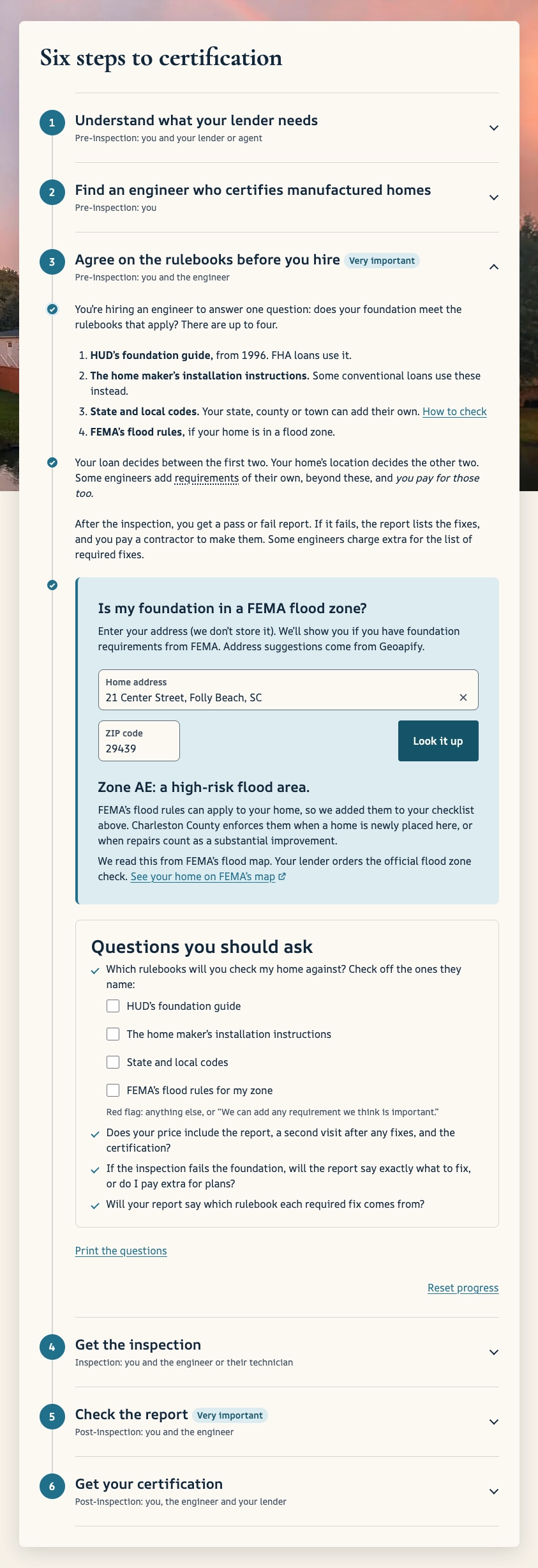
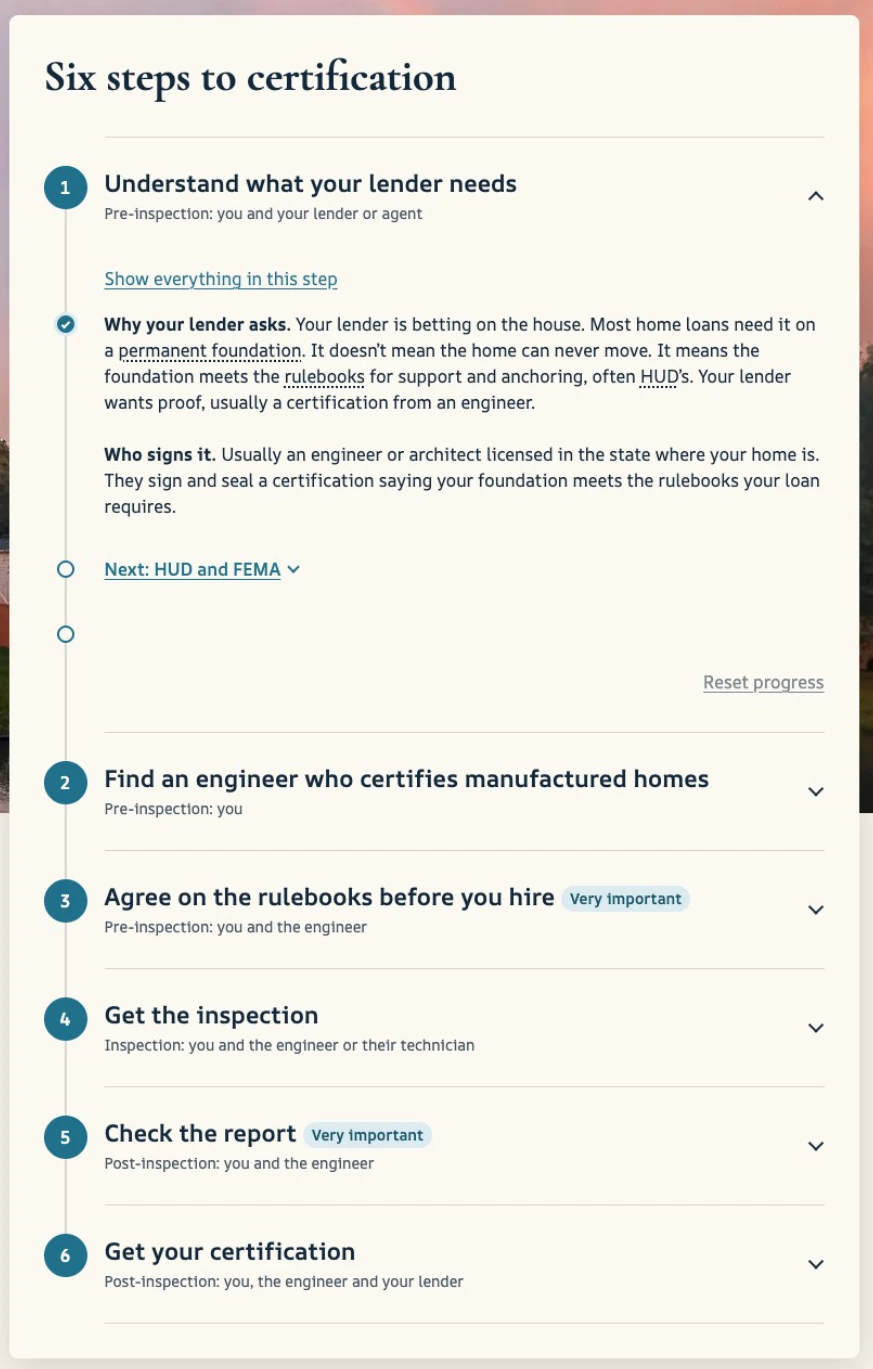
The guide borrows GOV.UK's step-by-step pattern: six numbered steps, and you open one at a time. The two that cost buyers money, agreeing on the rules and checking the report, are marked "Very important". The densest steps reveal in parts, so nobody faces a wall of rules at once.
Most buyers don't know what's coming. Each step sets them up for the next:
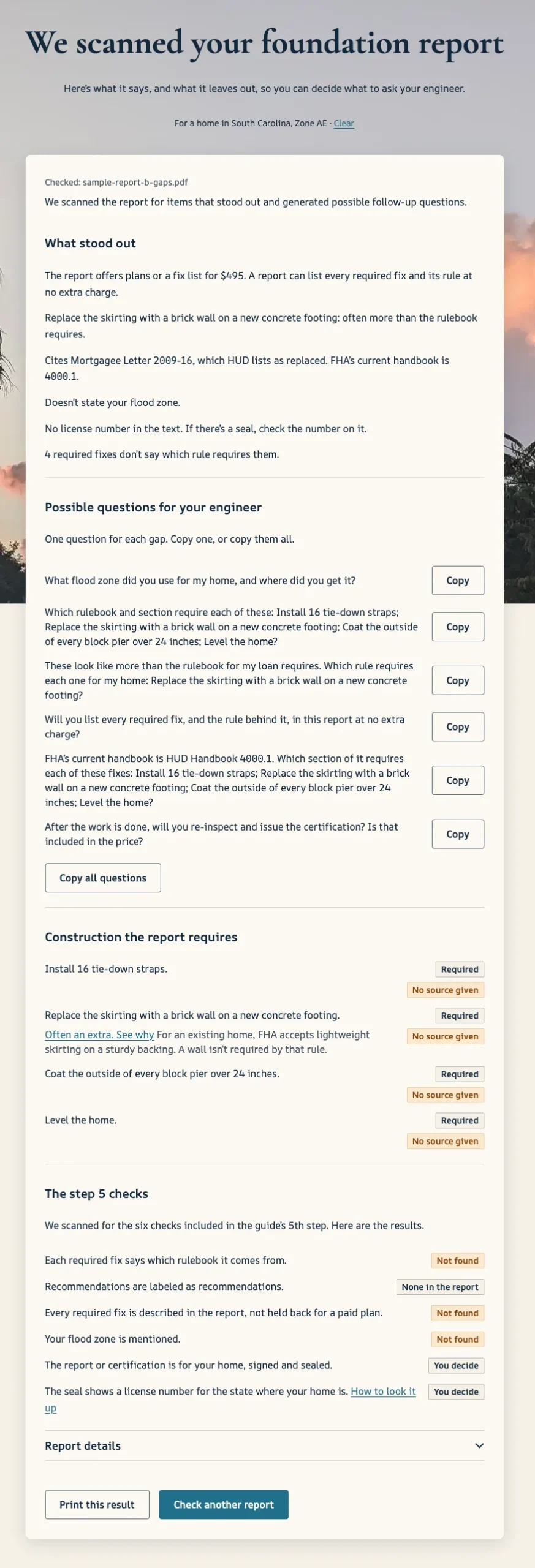
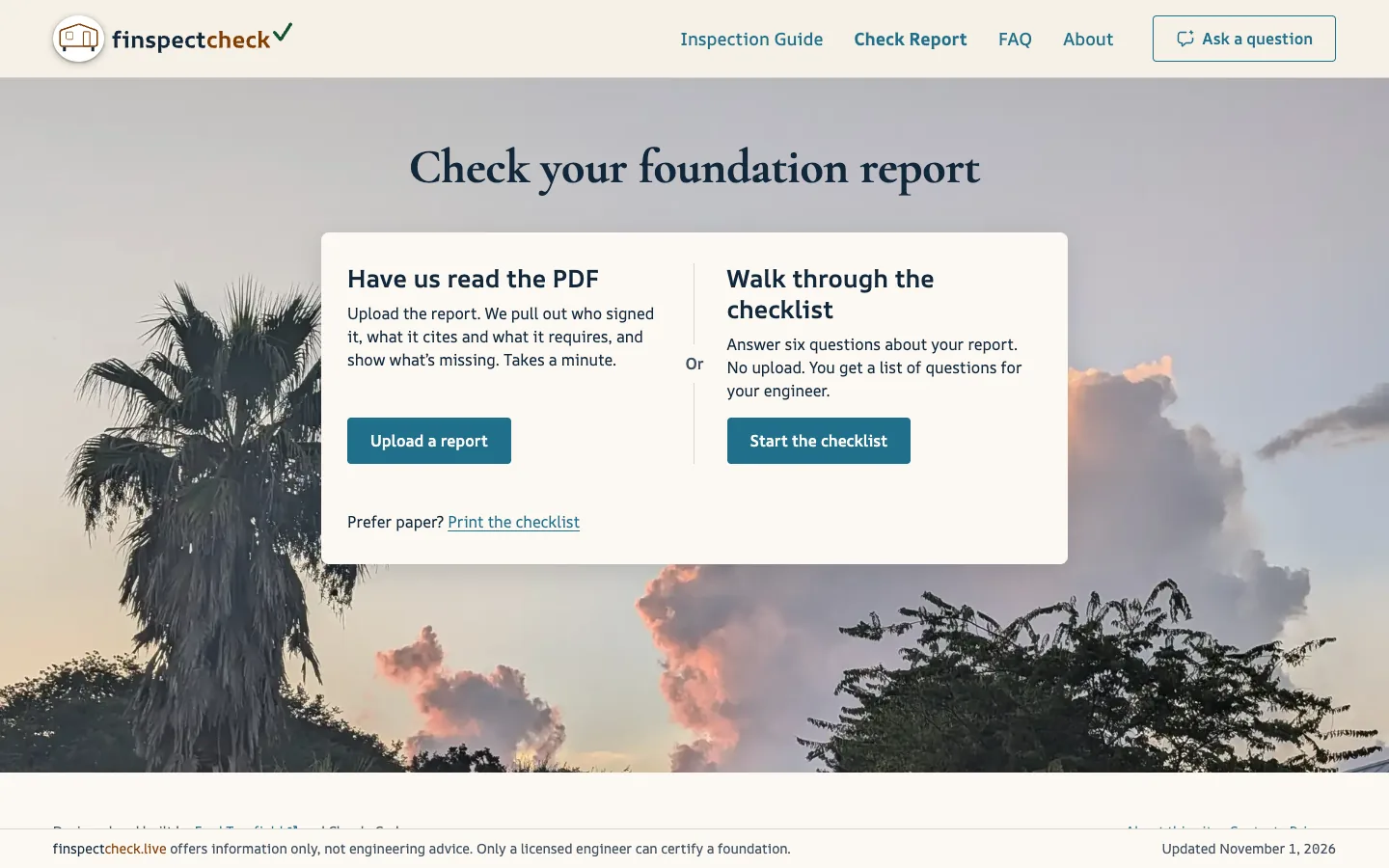
Very few home buyers know how to interpret the foundation inspection report. In step 5 they upload the engineer's PDF. The site reads it in the browser, scrubs out personal numbers, and has AI pull out who signed it, what it cites and what it requires.
Then it shows what stood out: a fee for plans, a wall the rules don't call for, a fix with no source. And it writes the questions to send the engineer. No upload? Six quick questions get the same list.
The AI only finds facts. Every sentence the buyer reads is written by the site, so it informs but never advises.
All three of our own reports said the foundation needed work. One offered plans for a fee, worded as optional. Initially the check missed it. Another named two rulebooks at the top, then listed fixes without saying which rulebook each came from. At first the AI credited both to every fix, so the missing attribution looked present. And all three put the license number only on the seal image, which the tool can't read. Each miss became a rule, and a test.
Claude Code is a developer tool: it plans, builds, tests and reports. Claude desktop is set up for research and writing: it read federal rules, checked sources and drafted copy. Same model family, very different working styles. I used each for what it does best, and carried the work between them.
No budget, so free tools wherever possible: shared hosting, cookieless analytics, a self-built contact form. The AI features run on a small model with rate limits, a spend cap and a kill switch.
My earlier AI-built, open-source project, Jtracker, taught me to write the rules down. Here they grew into files the AI loads on its own: reuse the shared component before making a new one; build desktop first until the layout settles, then "mobile go"; end every task with what needs me, what's done, and one next step. That last one finally tamed the firehose.
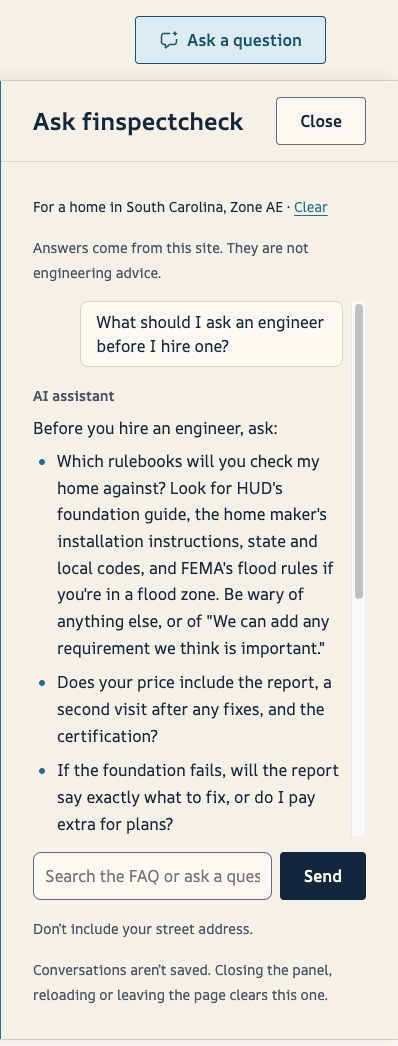
Buyers don't know the right terms, so a search box isn't enough. The ask panel is a conversational agent: plain-language questions in, short cited answers out, in two tiers.
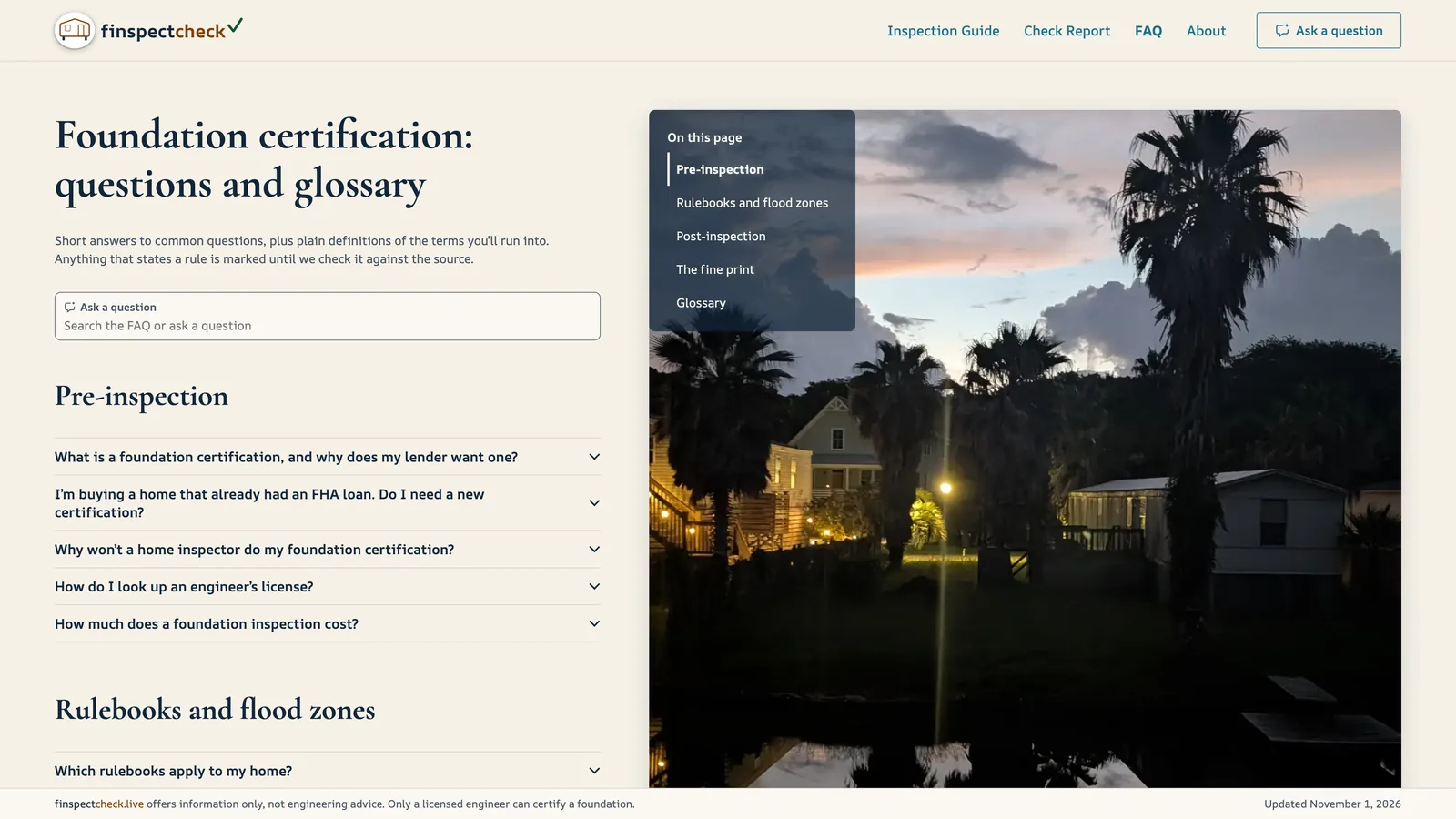
Thirteen short answers in four groups, from "What is a foundation certification?" to "What's the difference between a requirement and a recommendation?" That last one came straight from a realtor's review.
The glossary defines the jargon: FEMA, flood zone, P.E., rulebooks. Each term also gets a tap-to-open tip the first time it appears anywhere on the site, so nobody has to leave the page to learn a word. The same box that filters the FAQ hands off to the ask panel when a question needs more.
The bigger outcome is how I work now. In about a week I went from Figma mockups to a live product with an AI agent, prototyping in real code instead of handing off static screens.
I learned to direct two AIs like a small team: one to research and write, one to build, and me to design, decide and review every change (it takes some juggling). The instruction files and habits from this project now carry into new ones, starting with this portfolio.
Designing by prompt takes getting used to. For the nuanced calls, a quick Figma sketch shared with the Claudes beat a paragraph of description every time.
Same with code. I'm a perfectionist about spacing and type, and sometimes three lines of SCSS were faster than explaining them. But I didn't miss debugging TypeScript state and logic. Not once.
finspectcheck is live. Two realtors reviewed it before launch. One called it "a nice tool to reinforce what agents SHOULD tell buyers."
Manufactured homes cost about half as much per square foot as site-built ones (NAHB), so more buyers will hit the same certificate requirement. finspectcheck gives them the rules and the questions.
Long AI sessions lose track of early details and start contradicting themselves, and a chat that runs out of room means footwork is required to rebuild its context. Our research chat ran out of memory once. But the new chat was able to continue because I had Claude put every decision in a file, not in the chat.
Our foundation passed, by the way. It took three engineers and 22 tie-down straps.